
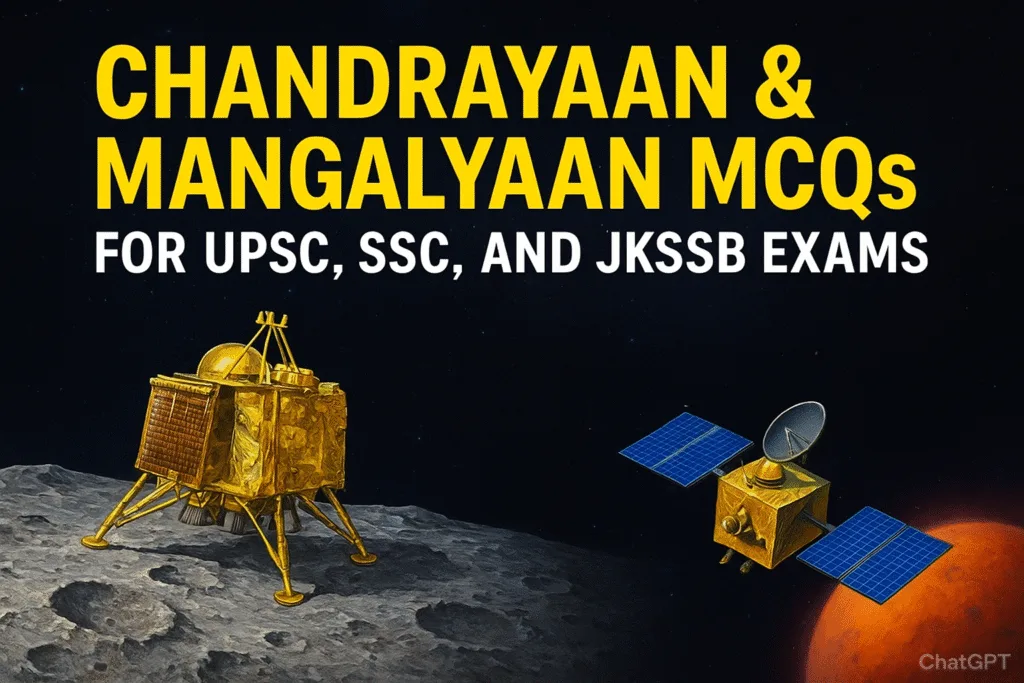
The modern achievement of science is the exploration of space. There are several missions to explore the solar system conducted by India and other countries. India’s space agency, ISRO, has carried out many missions like Chandrayaan-1, Chandrayaan-2, Chandrayaan-3, and Mangalyaan. Many missions have been launched by NASA as well. To know about these missions is very important for competitive exams, and questions are frequently asked. Keeping this in view, we have drafted an MCCQ series to help you in your preparation.
-
Which Indian space mission was the first to successfully reach Mars orbit on the first attempt?
A) Chandrayaan-1
B) Mangalyaan
C) Chandrayaan-2
D) PSLV-C25
Correct Answer: B) Mangalyaan -
Chandrayaan-1, launched by India, discovered the presence of water molecules on which celestial body?
A) Moon
B) Mars
C) Venus
D) Jupiter
Correct Answer: A) Moon -
NASA’s Mars Rover Perseverance was designed to study the Mars surface for what main purpose?
A) Detect magnetic fields
B) Study Martian storms
C) Search for signs of past life
D) Measure gravity
Correct Answer: C) Search for signs of past life -
What year did India launch its first lunar mission, Chandrayaan-1, into space?
A) 2010
B) 2012
C) 2006
D) 2008
Correct Answer: D) 2008 -
Mangalyaan is officially known by which full form describing its objective?
A) Moon Orbiter Mission
B) Mars Orbiter Mission
C) Mars Observation Mission
D) Mars Orbiting Satellite
Correct Answer: B) Mars Orbiter Mission -
Chandrayaan-2 included which three major components to explore the Moon’s surface?
A) Orbiter, Lander, Rover
B) Rocket, Satellite, Probe
C) Lander, Rocket, Telescope
D) Rover, Satellite, Telescope
Correct Answer: A) Orbiter, Lander, Rover -
Which country’s space agency collaborates with ISRO in several joint space missions?
A) Russia
B) China
C) USA (NASA)
D) Japan
Correct Answer: C) USA (NASA) -
Chandrayaan-3 was primarily launched to achieve a soft landing on which part of the Moon?
A) North Pole
B) South Pole
C) Near Side
D) Far Side
Correct Answer: B) South Pole -
Mangalyaan mission helped India become the first Asian country to do what successfully?
A) Land humans on Mars
B) Launch reusable rockets
C) Orbit Moon
D) Reach Mars orbit on first attempt
Correct Answer: D) Reach Mars orbit on first attempt -
Which NASA mission successfully landed humans on the Moon for the first time in 1969?
A) Apollo 11
B) Apollo 13
C) Mercury 7
D) Gemini 8
Correct Answer: A) Apollo 11 -
Chandrayaan-1 carried a payload from NASA that helped detect which element on the Moon?
A) Oxygen
B) Water molecules
C) Helium
D) Nitrogen
Correct Answer: B) Water molecules -
Mangalyaan mission used which type of fuel system to travel to Mars orbit efficiently?
A) Solid propulsion system
B) Hybrid propulsion system
C) Liquid propulsion system
D) Ion propulsion system
Correct Answer: C) Liquid propulsion system -
Which Indian space agency is responsible for launching satellites, space probes, and astronauts?
A) ISRO
B) DRDO
C) HAL
D) BARC
Correct Answer: A) ISRO -
Chandrayaan-2 orbiter carries how many scientific instruments to study the Moon’s surface and atmosphere?
A) Six
B) Seven
C) Five
D) Eight
Correct Answer: D) Eight -
NASA’s Hubble Space Telescope is used mainly for observing what in space?
A) Planets only
B) Stars, galaxies, and celestial objects
C) Asteroids only
D) Earth’s atmosphere
Correct Answer: B) Stars, galaxies, and celestial objects -
Which ISRO mission became the cheapest Mars mission in the world when launched in 2013?
A) Mangalyaan
B) Chandrayaan-1
C) Chandrayaan-2
D) PSLV-C25
Correct Answer: A) Mangalyaan -
Chandrayaan-3’s landing attempt used which kind of rover to explore lunar soil and rocks?
A) Moonwalker
B) Vikram Rover
C) Pragyan Rover
D) Sojourner Rover
Correct Answer: C) Pragyan Rover -
NASA’s Artemis mission aims to send humans to which part of the Moon in the upcoming years?
A) Near Side
B) Lunar South Pole
C) Far Side
D) Lunar Equator
Correct Answer: B) Lunar South Pole -
Chandrayaan-1 mission carried how many scientific instruments for studying the lunar surface and mineralogy?
A) Nine
B) Ten
C) Eleven
D) Twelve
Correct Answer: C) Eleven -
Mangalyaan’s primary objective was to study which aspects of Mars’ atmosphere and surface?
A) Mars’ gravity only
B) Martian moons
C) Mineral composition, surface features, and atmosphere
D) Magnetic field only
Correct Answer: C) Mineral composition, surface features, and atmosphere -
Which Indian rocket family is used to launch Chandrayaan and Mangalyaan missions successfully?
A) PSLV rockets
B) GSLV rockets
C) Agni rockets
D) Prithvi rockets
Correct Answer: A) PSLV rockets -
NASA’s Voyager missions aim to study which part of our solar system beyond planets?
A) Inner planets
B) Asteroid belt
C) Sun’s corona
D) Outer solar system and interstellar space
Correct Answer: D) Outer solar system and interstellar space -
Chandrayaan-2’s Vikram lander lost communication with Earth during landing attempt on which year?
A) 2018
B) 2019
C) 2020
D) 2017
Correct Answer: B) 2019 -
Mangalyaan carried scientific instruments to detect methane gas in Mars atmosphere. Which type?
A) Gas chromatograph
B) Infrared spectrometer
C) Methane spectrometer
D) Mass spectrometer
Correct Answer: C) Methane spectrometer -
Chandrayaan-3 mission demonstrates India’s growing capability in space exploration in which field?
A) Lunar soft landing technology
B) Satellite imaging
C) Rocket propulsion
D) Solar panel technology
Correct Answer: A) Lunar soft landing technology